Gear Selection
Spur Gear vs Helical Gear: How to Choose
Spur gears are simple and efficient, while helical gears offer smoother tooth engagement. The right choice depends on the complete transmission, not one advantage alone.
SINOF Engineering Team · · 7 min read
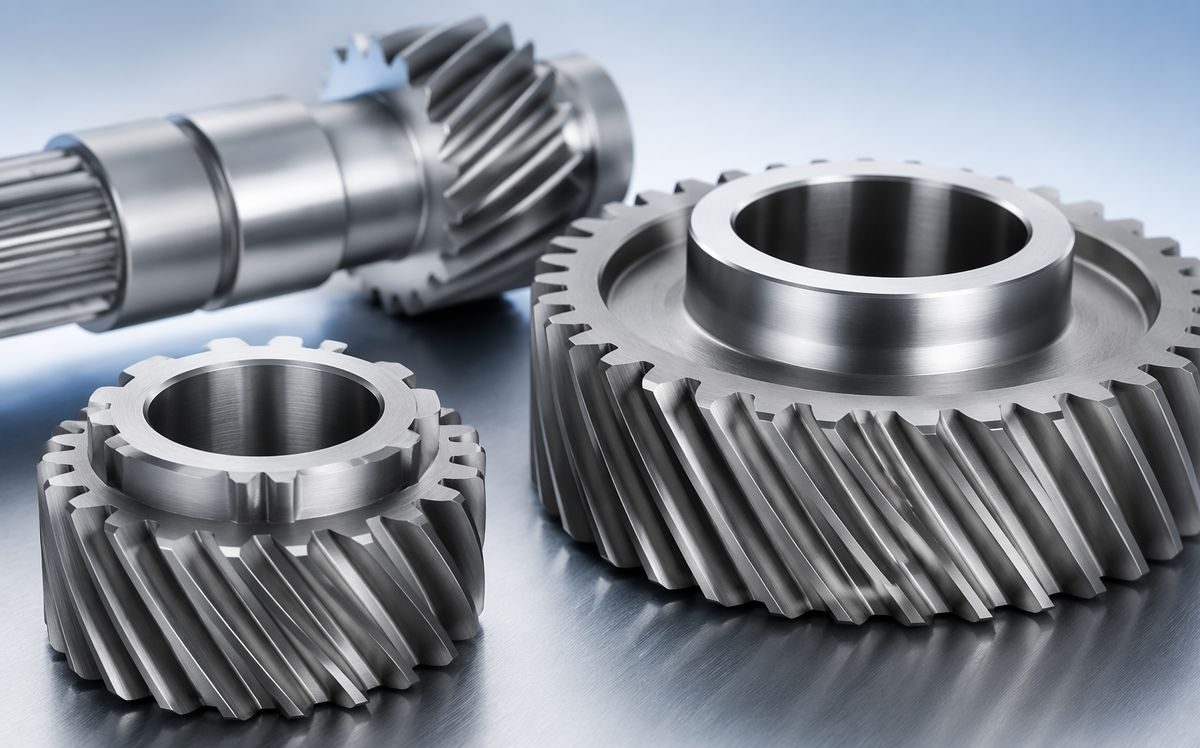
The fundamental difference
Spur gear teeth are parallel to the shaft axis. Helical teeth are cut at an angle, so contact begins progressively and more than one tooth pair may share load during part of the mesh. That geometry influences noise, load distribution, bearing reactions, manufacturing, and inspection.
Spur and helical gear comparison
| Decision factor | Spur gear | Helical gear |
|---|---|---|
| Tooth engagement | Engages across the tooth width more directly | Engages progressively along the tooth |
| Noise and vibration | Can be more noticeable as pitch-line speed rises | Often smoother when alignment and quality are controlled |
| Axial force | Normally no mesh-generated axial thrust | Produces axial thrust that bearings and housing must support |
| Efficiency | Generally high with straightforward sliding conditions | Can have more sliding and related heat generation |
| Load sharing | Depends strongly on face contact and alignment | Overlap can increase contact ratio and smooth load transfer |
| Manufacturing inputs | Tooth system and blank geometry are comparatively direct | Requires helix angle, hand, and normal/transverse conventions to be unambiguous |
| Typical selection pressure | Simplicity, efficiency, low axial load, compact cost target | Noise, smoothness, speed, and load-sharing target |
Questions to answer at system level
- What torque, speed, duty cycle, shock load, and service life must the stage support?
- How much noise is acceptable at the operating pitch-line speed?
- Can the shaft, bearings, and housing support helical axial thrust in both operating directions?
- What center distance, ratio, face width, and envelope are available?
- How will lubrication, temperature, alignment, and housing stiffness be controlled?
- Which accuracy standard, backlash target, and inspection records apply?
Practical selection guidance
Choose a spur arrangement when simplicity, efficiency, minimal axial force, and direct manufacturability dominate. Consider a helical arrangement when smoother engagement, lower noise, or additional contact ratio justifies the axial-load and sliding consequences. In either case, tooth modifications, alignment, material, heat treatment, lubrication, and gear accuracy can matter as much as the tooth direction.
A supplier should not select the final geometry from a short application label. Submit the duty data and mating components for engineering review before freezing the drawing.
Frequently asked questions
Are helical gears always quieter than spur gears?
Not always. Progressive engagement can reduce excitation, but accuracy, alignment, modifications, housing stiffness, lubrication, load, and speed also control noise.
Why do helical gears create axial thrust?
The angled tooth force has an axial component. Its direction depends on helix hand and rotation, so bearings and housing must be designed for the resulting thrust.
Can a spur gear be replaced by a helical gear without redesigning the gearbox?
Usually not as a direct substitution. Shaft forces, bearing arrangement, tooth geometry, center distance, backlash, face width, and mating components require a system-level review.
Discuss your gear drawing with our team
Share the drawing, quantity, material, accuracy target, heat treatment, inspection needs, application context, and requested delivery date.
Request drawing review